The Economics Journal > Strategy >
Gross National Happiness / Well-being (GNH / GNW) - A Policy White Paper
Economics Journal > Strategy > Happiness Economics >
The American Pursuit of Unhappiness
Policy White Paper
Gross National Happiness & Well-being Index
GNH / GNW Index
A New Socioeconomic Development Policy Framework
Updated Policy
Paper: June 10, 2018 (See updates and corrections section)
Consulting Paper: December 20, 2016 (Cameroon Government)
Happiness Consortium Paper: Feb 27, 2007 (European Commission Project)
Final Paper: December 18, 2006
(addition of statistics from NEF study)
Draft Policy White Paper: V1.1 Jan 15, 2006
Working Paper
V1.0 Jan 4, 2005
Executive Summary
The most important statement of the U.S. political philosophy is that of Thomas Jefferson s Declaration of Independence. It states: We hold these truths to be self-evident, that all men are created equal, that they are endowed by their creator with certain unalienable rights that among these are Life, Liberty, and the
Pursuit of Happiness."
Are current government policies making us happier or more stressed?
This white paper provides an analysis of the mental and emotional health liabilities produced by the current socioeconomic system. It also proposes several policy reforms to help address these liabilities. The paper summarizes the study in three sections: 1. Statement of the problem; 2. Root cause analysis; 3. Recommendations.
Note: While this white paper is written for the United States government, the analysis and recommendations are applicable to many other countries.
1. Statement of the Problem:
Why choose happiness as a subject for economic research?
Mental and emotional well-being of citizens improves their performance and broadens the intellectual, physical and social resources of a nation. Our research has found that happy people have better health habits, lower blood pressure, stronger immune systems and higher endurance levels. They cause less stress on the national healthcare system. Citizens with better emotional and mental health are easier to relate to and work with, tend to be better decision makers, are more creative, and outperform peers in problem-solving, innovation, persistence and productivity.
The current American socioeconomic system does not help the mental and emotional health of its citizens. According to the following independent research studies:
The University of Michigan's World Values Surveys (WVS) of 2004, ranks America at number 15 in population happiness.
The New Economics Foundation (NEF) study of 2006, uncovered a different world order where USA ranks at the 150th place.
Regardless of what one thinks of various studies, and of their ranking criteria, when it comes to happiness and mental well-being, the world s richest country (by GDP) does not make it into the top ten and further studies suggest that its getting worse.
Let's revisit the first question.
Are current government policies making us happier or more stressed?
- How many Americans are taking antidepressants or using alcohol or other forms of addictions as a way to cope with the pressures of the current socioeconomic system? Is the number declining or on the rise?
- How many people have lifestyles that are causing severe pressure on their psychological, emotional and relationship health?
- How many people suffer from chronic workplace stress, anxiety, low self-esteem, or some form of depression?
- Are the rates of social conflicts or sources of stress such as divorce, crime and lawsuits declining or on the rise?
According to the American Journal of Psychiatry, the rates of depression across almost all demographic groups have risen in the United States over the past 10 years, with major depression rising from 3.33 percent of U.S. adults in 1991-1992 to 7.06 percent in 2001-2002: In other words, it has more than doubled. There are no available studies for 2005, but from our own research indicators, it appears that it is getting worse. Doctors are now prescribing antidepressants to children and adolescents more than ever.
Depressed or not, if you live in America, you are probably burdened with more stress than previous generations (and other countries)
2. Root Cause Analysis
The ideologies and governments of this century that promised happiness, have left people with more material possessions, but less
psychological well-being. Many in our society are emotionally bankrupt and unhappy. The demands of life in our current socioeconomic system
require that we keep running and running with little or no breaks.
With increasing life costs, rising taxes, economic demands, and social and work pressures, far too many people are suffering from chronic stress, anxiety or anger. The term "rat race" applies more today than ever. Many people eventually experience this high-pressure lifestyle as burnout, exhaustion and/or depression. Many Americans are feeling unhappy at home and at work.
Our research shows that current studies under-report the number of people who suffer from frequent states of anxiety, depression, or stress. When asked, the surveyed subjects think that prolonged or frequent high-levels of social, work or economic stress are normal. Yet, they desire much more happiness in life. They simply, gave up on "happiness" and settled for "survival". But, it does not have to be this way.
To be objective, it is not entirely the fault of the government. More has changed in the last decade technologically, culturally, politically and economically than the entire past century. The degree and speed of change has posed enormous challenges for countries, organizations and their people.
We are all feeling the influence of these changes, whether it s the global competition, social re-engineering, political and military conflicts, outsourcing or power shifts. Unprecedented globalization initiatives exert an enormous pressure on the psyche of the average individual and family. In many areas, those changes enriched people's lives, and in some areas, they robbed people of their lifetime investments, whether it s a retirement account, career or a long-term relationship. And in some cases, those changes literally stole their souls and their future. (Scientists: please forgive the use of colorful words)
To make things even more complex, most of today s young professionals are entering this changing world under-educated and under-equipped to manage their own lives. While fluent in science, business or arts, they lack critical-thinking competency and life-management skills such as self-awareness (psychological and emotional), relationship management (communications and people skills) and social awareness (their social contract, rights and duties). Like their parents, most of the young professionals will drift through life racing for the "American Dream", going through very expensive trial-and-error lessons and struggling to achieve happiness and fulfillment.
3. Recommendations
This section of the paper provides a list of strategic
recommendations proposed by the International Institute of Management to
increase America s Gross National Happiness (GNH). The recommendations
address six main public policy areas: Government, Economics, Work,
Media, Education and Environment.
A) Government
The role of government should shift from managing economic
growth to socioeconomic development. American public policy should shift
its focus from:
- The standard of living to the quality of life
- Material possessions to well-being (physical, mental, and material)
- Unsustainable economic development to sustainable environmental development
- Consumerism to investment
- Economic-driven education to socioeconomic-driven education
The government can also make substantial improvements by implementing the following recommendations:
- Simplify people s lives through reformed civil laws and taxes.
- Establish new tax and budget policies in line with public mental, emotional and physical wellness goals. For example, provide funding for the promotion of positive psychology and cultural education in schools, workplaces and public media.
- Shift policy priority from waging wars (a major source of socioeconomic stress and long-term liability) to local socioeconomic development and foreign collaboration.
It is important to note that the success or failure of any new initiative is dependent on the sponsorship of the power centers within the socioeconomic system. The public must drive Congress to provide additional reforms to ensure honest representation by elected officials and by instituting controls on the abuse of power such as the promotion of private interests on the expense of public good, which is also a major source of socioeconomic stress.
B) Economics
In 1972, Bhutan's King Jigme Wangchuck coined the term Gross
National Happiness (GNH) (in a casual remark in a public policy conference) to emphasize the holistic values of
his government policies and Buddhist spiritual values.
(Note: the preceding statement is
erroneous. Please see
the "updates and corrections" section; Q3 )
While there has been no independent study to validate the success of Bhutan s national policies, Wangchuck correctly asserts that economic growth does not necessarily lead to contentment. His philosophy is to focus instead on the following four pillars:
- Economic self-reliance,
- A pristine environment,
- The promotion of culture, and
- Good governance
In the past 30 years, Bhutan saw ad hoc policy initiatives, but without a specific measurement framework or metric. Regardless of the King s future success in formulating and executing his national policies, the concept remains an admirable way to look at modern policy making. (Note: please see the "corrections" section; [Q3 and Q16] The origin of the GNH phrase and the human rights violation as a result of Bhutan's GNH pillars of "culture preservation" and "good" governance ).
A new integrated qualitative and quantitative approach is needed to assist in the creation of a new socioeconomic development model to measure and monitor the development of the nation's most important asset - its people.(Note: please see the "updates" section: [Q4] for the limitations of earlier initiatives and the distinction of the proposed solution in developing an alternative economic and measurement system to the traditional GDP economics )
A second-generation GNH concept (GNH 2.0) treating happiness as a socioeconomic development metric is proposed by the International Institute of Management. The Institute proposes to call it Gross National Wellness or Wellbeing Index (GNW Index) or Gross National Happiness Index (GNH Index), to credit the King of Bhutan for his inspiring vision. (Note: please do not confuse Bhutan's GNH generic political mission statement or concept (GNH 1.0) with IIM's technical breakthrough in designing a specific GNH / GNW socioeconomic development and measurement model (i.e. the first GNH - GNW Index metric). IIM published the first GNH Index years before Bhutan created and published their first local GNH Index. Please see "updates" section: Q1, Q2 and Q3 for clarifications )
The metric measures the socioeconomic development by tracking seven development areas, including the nation's mental and emotional health. The metric value is proposed to be an index function of the total average per capita of the following subjective and objective measures:
- Mental Wellness: Indicated via direct life satisfaction survey and statistical measurement of mental health metrics such as usage of antidepressants and rise or decline of the number of psychotherapy patients
- Physical Wellness: Indicated via statistical measurement of physical safety and health metrics such as severe and chronic illnesses, disability, obesity and unnatural deaths.
- Workplace Wellness: Indicated via direct survey and statistical measurement of labor metrics such as job income, purchasing power, jobless claims, job change, workplace complaints and labor lawsuits
- Social Wellness: Indicated via direct survey and statistical measurement of social metrics such as education quality and education levels per capita, discrimination, safety, divorce rates, complaints of domestic conflicts and family lawsuits, public lawsuits, and crime rates
- Economic Wellness: Indicated via direct survey and statistical measurement of economic metrics such as consumer debt, minimum and average income to consumer price index ratio, income distribution, disposal income available for retirement savings and investments.
- Environmental Wellness: Indicated via direct survey and statistical measurement of living environmental metrics such as nature and infrastructure quality including pollution, noise and traffic.
- Political Wellness: Indicated via direct survey and statistical measurement of political metrics such as the quality of government such as local democracy, individual freedom, domestic and foreign conflicts.
The above seven measurements were incorporated into the first Global GNH / GNW Index Survey in 2005
While the proposed new GNW or GNH Index may not be all-inclusive or provide perfect measures, the consideration of the above parameters is a good start when creating a new metric for socioeconomic development and policy management. The results of such survey help identify scientific relations, correlations and cause-effect dynamics. The weight of each dimension and sub-indicators can be customized to meet the current needs of each society or country; however health and safety dimensions outweigh other dimensions, except when a metric in another dimension influences the health dimension. For example, the availability and quality of water and soil in the environmental dimension may have direct impact on the health of the citizens as we have seen in Africa's Malaria epidemic and US cancer-causing asbestos-based manufacturing.
The Institute has noticed an initial interest in the promotion of a concept similar to the GNH Index in the western world. According to Nadia Mustapha s article in Time magazine, "The Strategy Unit, an internal government think tank that reports to Prime Minister Tony Blair, conducted a seminar on life satisfaction and its public policy implications." Germany, Italy and France are also considering such studies." While there is an increased political interest in GNH-similar initiatives, there are no concrete proposals that offer an integrated multidimensional framework to help implement and measure the performance new happiness initiatives. The proposed GNH Index can serve as a starting point for such efforts. (Note: Since 2005, several international initiatives were influenced directly or indirectly by the proposed GNW Index solution in this paper. Some of the initiatives updated their solutions to include breakthrough design features of the GNW solution and Index. Some cited the GNW Index, others did not (despite the striking similarities). Please see the "updates" section: [Q4 Q5, and Q6] for further information )
C) Work
Equal opportunity is not truly equal until all U.S. populations have equal access to the same quality of education and equitable development programs.
Governments can institute new employment laws to promote life and work balance and to guarantee a healthy (mental and physical) work environment.
Contrary to what some managers think, this recommendation does not have to incur additional costs or liabilities to their businesses, instead it will improve working relationships and productivity and reduce employee turnover. A smart corporate policy will ensure the development of its management team to transform a dominating leadership style into a coaching leadership style with better work and relationship ethics.
D) Media
Without controlling free speech and the commercial rights of media owners, the government can fund public broadcasting to produce
more educational and awareness programs to promote mental and emotional well-being, life management skills, and social bonding.
This can help change the public taste and demand for the type of information and commercial media programs.
E) Education:
If one googles antidepressants, the search yields about six million pages. The same search for "depression prevention" yields less than 50 thousand. If one googles "happiness education" the search yields less than 500 results! Even when using different search phrases, the results are more focused on treatment than prevention.
Many mild to moderate depression cases can be eliminated or at least greatly helped with personal life management and happiness education.
The Institute recommends that happiness education starts in schools by providing basic social education in applied formats to personal and relationship management including basic psychology, self-awareness, leadership development, communication skills, conflict resolution, and basic sociology (social contracts and civil duties).
F) Environment
Institutionalize and enforce better policies to promote a cleaner and safer environment. Example areas include city planning, art, spaces, reduced pollution, noise, traffic, health, and so on.
:::
What are White Papers?
White papers provide businesses and government leaders with a
list of questions, terminologies and discussion points that can be used
to address existing or emerging challenges and opportunities. Unlike
academic research papers, white
papers are succinct advisory documents designed for executive communication and
problem-solving. The structure of the white paper includes three main sections: 1). A statement of the problem or opportunity 2). Analysis of
root causes and driving forces 3). Proposed solution and implementation
best practices.
About the Author
Med Jones
is the president of the International Institute of Management, a US
based best practices education and consulting organization.
:::
Copyright License
Royalty-free use license is granted for educational (non-commercial) purposes, provided that the user/publisher includes a clear reference to the author(s) and International Institute of Management www.iim-edu.org (Please include the active hyperlink for online publishing). Although publishing parts of the article under fair-use is free, the use of GNH framework or GNH Index for consulting or commercial purposes requires a written permission and a licensing fee.
:::
References and Additional Resources
Bhutan, Environmental Conservation: The Bhutanese WayTshewang C. Dorji, Royal Bhutanese Embassy, New Delhi, 2004
Michigan University World Value Survey, 2004
Human Development Report (HDR), UNDP, 1998
Genuine Progress Indicator, Executive Summary, Redefining Progress, 1998
Gross National Development (GND), MTCG, 1998
Does Economic Growth Improve the Human Lot? Richard Easterlin, 1974
:::
Updates, Corrections and Questions
If we made an error in our
papers, feel free to contact us with correction
information and supporting evidence. The updates will be
listed in this section.
Q
2.1: Is the Gross
National Wellbeing (GNW) Index and solution
copyrighted by the Institute? A: Yes, Both works
(2005 & 2006) are registered with the U.S. copyright
office. Please see the
GNW Copyright Office and Library of Congress
Registration. Q 2.2: Who
plagiarized the GNH / GNW Index? In 2016, we discovered some famous
and connected researchers have presented to our clients
substantially similar solution to our GNW Index.
Upon further research we found that they had access
to our GNW Index paper on our website. We consulted
with independent academic experts, who compared both
solutions, and they confirmed the plagiarism of our
solution. When we contacted the
offending researchers, they admitted the
similarities, but they claimed that the solution is
based on a knowledge belonging to the distant past
and refused to acknowledge our prior authorship.
They disparaged the value of our solution and its
author, in private, while in public, they called
their similar solution a historical
milestone in economics development. They deprived us of our
authorship rights in private, while in public, they used
copyright sign to claim the same ownership rights of the disputed
solution and raise research funds. When we contacted
them again, they changed their defense
this time they claimed that copyrights does not protect ideas
and that their solution is different.
We note to the public that we are not claiming that
we were the first to design an alternative
development indicator to GDP or to research
happiness or wellbeing indicators, we acknowledge
that several pioneering authors contributed to the
domain before we did; On the other hand, we are
claiming the authorship rights to our specific
design that was considered by independent
researchers as a developmental milestone and was
later kidnapped by the offending researchers, then
attempted to sell the solution to
our prospective clients, thus violating
academic integrity standards and fair-use rule.
We are researching available dispute resolution forums to reclaim
our rights. We do not wish to restrict researchers
from creating their own indicators, but we ask that if
researchers use our work, then to follow the
fair-use rules and cite our solution in their
academic papers.
Future Q&A
about who do we think plagiarized our solution is
expected to be published on this page in Q1 2019.
Q 3: Is the phrase Gross National Happiness
(GNH) copyrighted by IIM or Bhutan? Who coined the
GNH phrase? A:
No one owns the GNH phrase. The GNH phrase is
a simple phrase with a clever play on words, it cannot
be copyrighted. The origin of the phrase is misattributed to
the King of Bhutan. However more than one
person appears to have used the phrase before he did. First, according to
our research, the earliest
documented use of the phrase Gross National
Happiness (GNH) appeared
in
"Encyclopaedia Universalis" France, Volume 17, Year
1968 (Page 164). The phrase was also used by
several authors from 1970-1980. At the time of this
update, there are at least three claims of origin.
They include the following: Sicco
Leendert Mansholt (Netherlands) who served as the
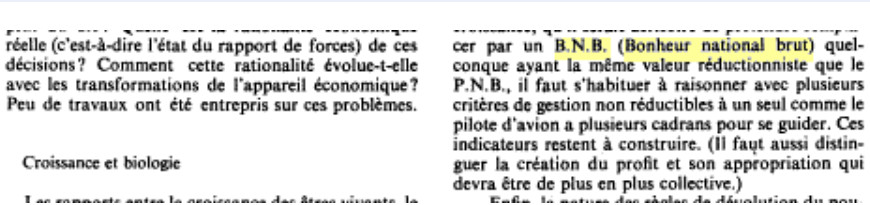
4th President of the European Commission. In 1972 He called
in a letter for
Gross National Happiness (GNH)
instead of Gross National Product (GNP). (see
page 184, "BNB" in French = GNH in English).
The second
claim is for Karna Sakya (Nepal) in a 1982
conference in Hawaii called "Culture Heritage
Conversation". The third claim that we cited in our paper, above, is for the King of Bhutan in 1972
who at the time was a young teenager.
However, after being informed of our error and
upon further research, we found that we have made a
mistake by attributing the phrase to the King. We are not the only ones to make that mistake, this mistake is the
result of a widespread media misinformation about
the origin of GNH as a replacement for GDP. This
misinformation maybe attributed the Center of Bhutan
Studies (CBS) - An academic research organization
connected to the government of Bhutan that led the
promotion of Bhutan GNH in western media, academia
and inter-governmental organizations. We are not
sure if the government of Bhutan is fully aware or
approves of CBS practices, we believe such practices hurts the
credibility, trust and legacy of the country and its
development.
Second,
we found a
credible academic study by Professor Lauchlan T.
Munro, at the Faculty of Social Sciences,
University of Ottawa, who served as the Chief of
Strategic Planning with UNICEF and Vice President of
the Canadian IDRC organization that funded Bhutan
GNH Research. From 1985 to 1987, he was a member of
the Royal Bhutanese Civil Service. During his time
he found no evidence of the GNH policies and traditions as claimed by
the Center of Bhutan studies (CBS). He published an academic paper
investigating the history of GNH and provided
evidence of false and misleading academic and
government statements, and academic misconduct in pre-dating
events in order to invent a history of tradition.
The paper is titled
WHERE DID BHUTAN'S GROSS
NATIONAL HAPPINESS COME FROM? THE ORIGINS OF AN
INVENTED TRADITION
. Professor Launchlan
also lists contradictory historical accounts and
claims by the Center of Bhutan Studies (CBS), the lead
academic and inter-governmental promoter of the history of GNH.
In one document, CBS claims the date of "coining"
the GNH phrase is in 1980s, in another
document the date is changed to the 1970s. Third, our direct communication with the Center of Bhutan Studies (CBS) on this and
other research issues, led us to conclude that
Professor Munro is correct.
Thanks to Professor Munro's rigorous
research work, we stand corrected. Our researchers
also discovered additional serious research
misconduct
that might have been intentional or unintentional. If our conclusions are contested by
CBS or Bhutan's government, we will share additional
supporting evidence regarding these issues on this
page. Q 4: What is
the social impact of the GNW think
tank paper? A:
For the international socioeconomic, political and
academic impact, please visit the
Gross National Wellbeing (GNW)
Industry Recognition and Citations page. Q 5.1: Can you
share practical / real-life applications of GNW Index in public policy? There are several applications for the GNW Index,
each application can be customized to individual
national or local policy needs. The following are a
few policy
plans and implementation examples: North America: 2009
USA's
New York City Green Light District Community
Wellness Planning: Gross National Wellness
(GNW) Guiding Policy and Measurement
Dashboard(pages 103 to 118) 2011 Canada's
Edmonton City 2030 Vision: Sustainable
Development report: Potential Measurement
Approaches - The International Institute of
Management Indicators that influence
happiness. (page 14) Africa: 2011
Ethiopia's Social Protection
Management using
Gross National Wellbeing (GNW) Index Measurement
2017 Nigeria's
Agriculture and Fishery Industry Policy
Impact on GNW Index Measurements Asia: 2011
India's Goa State Vision 2035: Making Goa the first state in India to measure and monitor happiness as
the most important socioeconomic development
indicator (page 111) 2016 Bangladesh
Planning Commission: A Development Planning
Framework Option (page 45) ::: Q 5.2: Can you share
your new research or data with the public for free? No. Our work was plagiarized
by other researchers and we decided to stop
publishing or sharing our work publically until we
reclaim our authorship rights. We are a private
research think tank. Although we sometimes publish
our work to educate the public and market our
services, we
do not have public sources of funding. We make our
revenue from consulting and training services.
Unlike academics who are supported by university
salaries and research grants.
We need to sell or license our services in order to survive and grow.
Q 5.3: What does a "Per Capita Index" mean? A simplistic explanation of
terminology for non-economists: Econometrics can be
defined simplistically as economic-metrics or
economic measurements. It is a branch of
economics focusing on the analysis and design of
measurement solutions to help identify and solve
problems in various industries, including public
policy. Researchers and consultants attempt to
design and create new solutions, models, and
tools to help improve the analysis and policy
formulation. "Per capita" means
per person. Mathematically, it is calculated by
taking any measure of a country and divide it by
the total number of the population in that
country. For example, you can take the total
income or GDP, in US dollar amount and divide it
by the population number. This allows economists
to measure the total income created by a society
in relationship to the total number of people in that society. The use of averages and ratios
allow economists to compare countries of
different sizes. Benchmarking means
comparing to another reference value (a
benchmark number). For
example, when comparing a group of countries,
you choose a reference point for comparison,
such as the country with highest or lowest
income or the average value of all compared
countries. You can also compare a country's
annual GDP per capita to a reference point in time, such as last year or a reference year to
see progress.
"Normalization", the
term can have multiple meanings, one meaning is
(to normalize) or to adjust different
measurement scales to one common scale. For example, how can
you compare an income per capita in USD
(measured in currency per person) with the
standard crime rate (measured as a rate per
100, 000 of population)? Statisticians use a term
called "normalization", i.e. adjusting them to a
common scale (so you can compare "apple to
apple"). They usually convert values on a scale
of 0-10 or 0-100. If you visit the
Global GNH / GNW Index Survey, you will see
an example of how the scale for each dimension
is normalized or adjusted to one common
scale from 0-10 to measure subjective happiness
in relationship to other objective dimensions of
wellbeing. An Index measures the
change in the performance (the progress or
regress) of virtually anything (such as an
income per capita, production, stock market,
healthcare cost, crime rate per 100, 000,
happiness levels, etc.). For example, an Index
can be used to measure the percentage of change
in an income of a country over a period of time.
Mathematically, an Index formula is a time
series function summarizing movements (changes
in value) in a group of related variables. Correlation: Correlation
analysis attempts to see if two factors are
related to each other, that is if they behave in similar or opposite manner and to what degree.
For example, does higher education level results
in higher happiness? If yes, then to what
degree? Causation (cause and
effect): Causation analysis goes beyond
correlation analysis, it attempts to find what
is the cause and what is the effect of two or
more factors. For example, in a certain period
of time, one research finds violent crime is
higher in black communities. Statistically
speaking, it can be said there is a positive
correlation between the color of the skin and
violence. However, such research is highly
misleading (even if statistically sound) because
it provides an incomplete association analysis.
Further research reveals that the cause is not
the color of the skin, but rather the historical
conditions (including slavery and explicit and
implicit discrimination) leading to lower income
and education and therefore more violence. So,
the cause is not the color of the skin, but the
lower income and education.. The same can be
true to any superiority or inferiority
association. The root cause problem of
stereotypes and prejudice against or in favor of
a person or a group or a policy (conservative or
liberal) is usually the lack of sufficient
causation analysis. Contrary to the perception
of non-economists, the Index math functions can be
easily applied and trailered using automated tools
using Excel or other software and does not require
major investments. Each one of the above
statistical methods or mathematical functions
(Index, averages, per capita, benchmarking and
normalization, correlation, GDP per capita, etc.) are well-known
among economists and statisticians. When an
economists propose an average, a per capita or an
Index function, they do not have to explain in mathematical notation what they mean, the techniques
can be easily understood by other economists; The
real challenge (and therefore the real value) is how
to select from all the available
knowledge elements, then combine them in away to create a new knowledge to
solve existing complex problems.
The first generation GNW Index
created a multi-dimensional single measure to track the progress of
happiness and wellbeing of a society in each of the
dimensions (variables) of wellbeing as well
as the aggregate (total sum) of all dimensions,
thereby allowing benchmarking (comparing) progress
over time and against other societies on each
dimension and all dimensions combined. The Index
model is flexible to allow policymakers to place the
same or different weights to each dimension and
sub-indicator thus allowing them to focus on one or
more areas and see the impact on the total happiness
and wellbeing score.
Prior to the GNW Index, happiness measurement were
simplistic, subjective and unreliable. They were
based on surveys that asked general questions such
as "how happy are you?" or "how did you feel yesterday
compared to today?" or "how satisfied are you in life?"
The GNW Index changed that by creating a holistic
and unified conceptual framework that integrated the
subjective with objective measurements, by asking
about happiness and satisfaction in each dimension
of wellbeing and then aggregating the total score.
This way, economists and the person surveyed can
give a more precise and less subjective answer and
rating about happiness and wellbeing in each
dimension in life and overall.
The GNW Index unified, holistic, and integrated
structure allows the individual, economists,
psychologists, sociologists, and policymakers to
know the causes of happiness and unhappiness in each
dimension and how they impact the aggregate feeling
of life satisfaction and objective wellbeing over
time.
Policy makers can also make more informed decision
on how public investment projects impact happiness
and wellbeing on each dimension and total score over
time.
The other advantage is that it allows policymakers
to correlate between pure objective measures and
pure subjective measure of life satisfaction in a
360-degree (full view or holistic) multidimensional manner, rather than partial,
skewed, or unbalance manner.
The social impact and applications of such solution
are far-reaching. For example, policymakers can use
the GNW Index to allocate national investments
across the dimensions of wellbeing and measure the
performance of those investments on each dimension
and the total score, the GNW Index also allows them to compare
the performance of these investments to other policies in other societies. One less
used, but more important application of the GNW
Index is political conflict studies, including peace
and war studies, where causes of political tensions
and conflicts within a society (economic, ethnic,
civil conflicts, etc.) and between societies (cross
border wars). Prior to the GNW Index, no econometric
solution offered a single measurement unit based on
an integrated, holistic, unified and flexible
multidimensional econometric system existed that
allowed such holistic policy-making application, in the same way that the GNW Index did. Q 6: Why did you
create the GNW Index? What is the purpose or
value of the GNW
Index? What are the main design features of GNW Index
solution? (Combined Questions) Although the GNW
solution and Index was the product of a creative process and was
based on earlier multi-national and multi-cultural
personal and professional experience.
Later historical and comparative research discovered hundreds of
fragmented indicators and a few partially integrated
measurement solutions that existed before.
Despite their valuable insights and contribution to the total heritage
of socioeconomic policy and wisdom, they were severely deficient in measuring
subjective (happiness) and objective wellbeing, let alone measuring
subjective happiness in relationship to each and all of the critical
objective dimensions of wellbeing. For example, we found studies that measured crime rates, but
not pollution; income inequality, but not poverty;
the number of doctors or
hospital bed per capita, but not (the more important) mental and physical health
indicators such as depression or
chronic diseases; income per capita, but not unemployment rate;
employment but not work-life balance; environmental pollution, but not
urban noises or traffic congestion; religious affiliation, but not
political wellness indicators such as domestic and foreign conflicts. More importantly,
despite their pioneering insight and value at the
time, the existing life satisfaction studies were
simplistic, incomplete, too generic and unreliable
to guide any practical public policy actions, they
rated the generic feeling of satisfaction in relationship to income and other few fragmented
indicators, they were not fully integrated into a
holistic multidimensional
subjective and objective measurement system in relation to each and all the dimensions of wellbeing
and were not expressed in a unified measurement unit
that allow its adoption similar to the GDP
indicator. For example, one of the most important
indicators of happiness and wellbeing is the quality of the family
relationship; no measure of subjective or objective wellbeing is
complete without
measuring social stress, mainly, family stress using
indicators such as divorce rates and single parenthood, especially
considering that half of marriages end in divorce. It is a well-known
fact that social relationships and more importantly,
the quality of family life is the cornerstone of mental, emotional
and behavioral wellbeing. Measuring happiness in relationship to income and other indicators
without including relevant social and family indicators is incomplete at best and
may not result a reliable subjective or objective
wellbeing conclusions. If some studies measured
divorce rates as an indicator of social wellbeing,
they overlooked major other subjective and objective
dimensions. Additionally the design of the old
partial indices (labor index, social index, human
development index), not only they where limited in their measurements, they were fixed and
restricted in their measurement output, they were
not flexible enough to allow weighting of
dimensions. So they do not allow the experimentation
(what if scenrios) and reflection on the
relationship between each wellbeing factor and other
factor, and the total score.
Upon recognizing that our GNW solution was
plagiarized by some researchers, we did a more
detailed study of publically accessible research and
found that the scholarship in the pursuit of
happiness and wellbeing started as early as the
Chinese and Greek philosophers (B.C.). Many of
them identified many factors of a happy and good
life. We found some academic research papers that surveyed
those philosophers and some of them became famous
researchers, yet their research, in our opinion, is
unoriginal, fuzzy and contributes no real value for
public policy or the science of happiness and
wellbeing policies. If you
ask a group of a few people what makes them happy or
unhappy, you are likely going to get a list of
potentially overlapping factors or dimensions (yet
not necessarily the same); you do not need a rocket
scientist to tell you what makes people happy, yet
we found many academics who appear to be fascinated
by citing early philosophers or famous (yet
unoriginal) researchers for apparently paraphrasing
old-age insights in academic language, despite the
volume of the research literature, some of them even
missed some critical dimensions. In their
writings, they were probably trying to show that
they have done their homework or that their research
knowledge is vast. In their pursuit of knowledge,
they either suffered from too much focus or
information overload, we call these ivory tower
academics whose writing are based more on books and
much less on real-life and consulting experience,
they did not spend sufficient time outside academic
compounds and closed policy chambers, they form a
networking group at some high-profile
publishing journals and some inter-governmental
organization. They demonstrate self and group
citation bias, at the expense more original authors
even in academia. Some we suspect browse the
internet for new and innovative solutions from the
private sector or government professionals and
reframe it as their own contribution to academic
publishing by adding citations to relevant academic
article, while omitting original source of the
innovation. Our forensic analysis and investigation
found that this has happened not only to us but to
other authors.
On the other hand, and to be fair, we also found few pioneering
studies and solutions that were successful in the
creation of concrete and useful measurement units,
among the more well-known studies, yet incomplete
measurement units (partial measurement,
un-integrated, non-holistic, or use different
methodologies) are;
Note: Some earlier initiatives updated their design
model after 2005 to include additional wellbeing
dimensions and indicators to something similar to
the GNW Index, but did not rename their model to
version 1.0, 2.0 and so on, thus misleading many
academic researchers. You will find their papers
reference wrong dates and
design. In short, despite the
great contribution of these initiatives to the body
of knowledge of happiness and wellbeing measurement science, these proposals
and the indicators were fragmented, partial and
limited in measuring subjective and objective
wellbeing. Incomplete measurement system and
fragmented indicators can lead to wrong conclusions
and policy actions. We also note that just because
we think these solutions are incomplete, it does not
mean they are of any less value as a developmental
milestones; these solutions and insights broke through the
limitations of prior measurements and should be
credited for their contribution. We are also confident
that future researchers will recognize the
limitations of our GNW Index and propose better
solutions. The institute's first GNH and
GNW Index was
recognized by
some scholars and policy makers for one or more of the following
ten
contributions: Prior to the GNW Index,
many policy makers and their advisors recognized
the limitations of traditional economics and
called for the development of alternative
models, but they could not implement their
vision due to the lack of a practical tool with
a complete econometric system that integrates
subjective and objective measures. Many
psychological surveys and research papers on the
topic of happiness, existed; however, few
economists and government officials, if any,
took seriously the concept of happiness as a
development policy; in our opinion, this was
mainly due to the difficulty of measuring the
subjective nature of "feelings". Mainstream
economists did not consider
happiness as a main policy objective. To the
best of our knowledge, the GNW Index was the first
published complete policy management system to
quantify happiness and integrate it into an
econometric tool in relationship to other dimensions of
health, political, social, workplace, economic and
environmental well-being. From a political
perspective, we believed that one of the main causes of failure of prior political initiatives
in implementing happiness and wellbeing policies
is the subjective nature of happiness. Most economist would not
touch intangible non-quantifiable subjects. We
aimed at creating a new survey and measurement system to
overcome that thinking and implementation gap.
For example, in our opinion, the Bhutan's GNH
philosophy was nothing
more than a good mission statement with no real advances
for decades.
Almost all enterprises start with an inspiring
mission statement, but fail to progress due to
lack of practical execution and management
tools. This also explains the widespread poverty
and social problems in Bhutan for the past
decades. Visions cannot be implemented without a
proper measurement system
and tools. The adage "you cannot manage what you cannot measure"
is true in this context. In 2012, Bhutan published
their local GNH Index. Most of their design
implementation match the first IIM GNH / GNW Index, with the
exception of of the addition of karma, prayer,
and cultural preservation indicators. We
disagree with such inclusions for democratic and diverse societies. Create a
synthetic multidimensional measurement metric
that unites the measurement of progress of
happiness and wellbeing in a context of sustainable development, the aim
was to create a new measurement indicator similar
to what the GDP indicator did to fragmented economic
measurements more than eighty years ago.
Although there were many
advances in happiness psychology as a science,
and some pioneering breakthroughs in welfare
(poverty) economics, happiness economics was
(and remains) in its infancy relative to other
social sciences. To the best of our knowledge,
at the time of the publishing of the GNW Index first
working paper in 2005, happiness policy
initiatives were generic, abstract, and
subjective mission statements. They lacked concrete integrated
econometric and scientific decision-making
measurement unit for measurement of progress and effective implementation,
let alone provide a viable metric to supplement or replace GDP.
The situation was
similar to the creation of GDP; prior to GDP, there were many
fragmented measurements. GDP created a
metric that allowed governments and economists
to measure economic activities and growth. Our
GNW index aimed to create an Index that
integrates happiness and wellbeing economics and decision-making frameworks into a unit to measure the
progress of wellbeing (subjective and
objective) as the main socioeconomic development
metric. Since 1998, the author submitted similar
metrics and proposals to government
agencies, but the one
that proved most popular was the GNW Index. We
believe this is in part due to the completeness
of the framework, the integration
of subject and objective components, and
redefining the subjective components in relationship to the each and all the critical
dimensions of objective wellbeing.
Redefine
happiness from the traditional subjective psychological context of general
and unreliable rating of
feelings (asking questions how do you rate your life
satisfaction) to a holistic, specific and concrete wellbeing economics
context with the creation of a measurement unit
that rates satisfaction for each of the main dimensions of wellbeing and combined together as one
complex synthetic measurement unit to provide more
accurate assessment of happiness and wellbeing.
Please note that this is a major distinction from the famous
pioneering but partial correlation attempts that
existed prior to the GNW Index and surveyed
people on their happiness or general life
satisfaction, or correlated happiness with income (Easterlin,
1974),
or religion or culture (World Value Survey
2004). In our opinion, the relative and
subjective aspects of happiness makes it
difficult to quantify in a reliable manner. This might explain the reluctance of economists
and scholars to address this area of research
before 2005 and the sudden explosion of
studies on the subject by famous academics and
their followers.
Our research found that international
development agencies and governments had large
collections of statistical indicators that were
mostly used in silos to measure the performance
of an individual sector or dimension; We believe
that the GNW Index provided the first fully
integrated 360-degree tool for economists and
policy makers to effectively measure and manage
the well-being of their citizens. There were
earlier attempts to create a similar solution
but the dimensions were incomplete,
methodologies were different, &/or they did not
integrate subjective and objective measures.
Some of the noteworthy pioneering attempts are
the Human Development Index (HDI) and Genuine
Progress Indicator (GPI). The GNW Index aimed to
change the paradigm of governance from economic growth to
happiness and wellbeing development. Use the solution
to evaluate (measure) the outcome of
public policies and investment portfolio of
public projects.
One of the important applications of the gross
national wellbeing (GNW) solution is for public
investments to measure the strategic wellbeing
return on investment in public policies and
projects. We call those metrics ROW (Return on
Wellbeing) or Return on Happiness (ROH) instead
of the traditional ROI (Return on Investment). Create a flexible
solution that can be used by different policy makers
with different political priorities but use a
common communication and reporting framework to
bridge political views and communication gaps. We hoped that the
measurement system will become a holistic
executive-government
accountability framework for elected officials and
for citizens to evaluate their government
performance.
The GNW Index is designed to provide
accountability and transparency and reporting to
all stakeholders including but not limited to
the citizens, congress (parliament) and
government agencies. Heads of states competing
for election can now have a clear system for
debating the issues, instead of misleading
themselves and the public by using generic mission statements with no real
measurements.
So, if they say, we want to invest in a project
to improve one of the development areas,
the question they have to answer is at what
expense and what is the cost of lost
opportunities in other dimensions. Help develop and
increase happiness and wellbeing within communities and nations.
The management system is designed to be flexible
and therefore it is not politically restrictive; it allows heads of
states with different priorities to use the same
flexible solution with varying weight on the
investment measurement model. However, one of
the more important functions of such solutions,
is the removal of blind spots in decision-making
and allowing the leaders to see the individual and
social wellbeing impact of any major investment
shift. Some believe, that the GNW Index opened the door
for several international initiatives. The new
science of happiness economics is filled with
new and exciting developments that promise to
advance well-being policy-making all over the
world. Note: Just because we
are attempting to distinguish the value of our
contribution and reclaim the authorship credit of
our work, it does not mean that we do not value
earlier contributions by other pioneering
researchers who opened the door for future
innovators, including ourselves. ::: Q 7: What is a policy white paper? What is
the difference between academic papers and white
papers?
A:
A white paper is a brief consulting paper used to
introduce innovative solutions, out of the box
thinking, opinions and views on major problems,
risks, and opportunities to clients. White papers
serve as business development and education tools
used by think tanks and consulting firms to create
market awareness, educate and serve the public and
clients. Most executives are more interested in practical solutions than academic theory. Academic
papers, however, are research papers that are
usually written by a person with an academic title
such as a scholar or a professor. They are required
to conduct a thorough survey of existing literature,
the papers tend to be longer with more annotations
and references. Sometimes the two types of papers
overlap in purpose, function and application. After
we published the GNW Index as a white paper, the
design of the Index found its way to academia and
gained many supporters, some academics contacted us
to make corrections to some citations and we did
that without any hesitation. We believe that
correcting an error in any article demonstrates
professional integrity, while covering up a mistake
is an act of intentional dishonesty driven in part
by pride or hubris, which is almost always worse
than admitting to making a mistake.
Although the GNW Index was the baby of a creative
process, we learned a lot in the past decade about
the emerging academic research in the field, the "hunger" and the
competition among academics to create better
systems of measurement and decision-making for policy
makers. You will post future public updates on this
page.
A:
Yes. We encourage scholars to do so for the public
benefit. We consider this type of work as fair-use.
We do not charge money for spreading happiness and
we do not want to restrict fair-use and progress.
However, if your work uses our solution, but you fails
to credit us for the original authorship, or if you
charge money for consulting or commercial purposes,
then you may have violated the fair-use rule and may be
required to pay damages arising from any resulting
plagiarism, intellectual property rights
infringement, false advertising of origin, and/or
unfair competition. Academic standards require
thorough research and the citation of the
original author
of the main ideas in your paper. If you
unintentionally overlooked the citation of the
original source of the
main idea behind your work, you are expected to
quickly correct your paper in order to prevent
misleading the editors and the readers and causing
further damage to the original author. Additionally, selective
referencing in favor of politically or academic
affiliated authors at the expense of an original
author is also considered professional and academic
misconduct and requires correction or risk academic
and other sanctions. Q 9: If we reference
your Institute, can we print and distribute copies
of your articles?
A:
You can print it royalty-free for education purposes
while adhering to fair-use rules. If you plan to use our work,
or any part thereof, in any way for which you charge
money or for commercial purposes, including consulting,
then you will require a written permission from
us and may be required to pay a licensing fee. If
you are in doubt as to whether your planned use of
any of our work falls within the fair-use doctrine,
please contact us we may be able to make an
exception for some clients in developing countries
on case-by-case basis. We can also make an exception
for journalists. Q 10: Why don't you
publish your papers in academic journals?
A:
Although some of our members
are academic researchers, we are not an academic
institution. We are an independent private think
tank. We are not funded by donors or governments. As
an independent entity, we have to make money to
survive. We are for profit-with-a-purpose
organization. Unlike most universities or professors, we do not
receive public funding to support our research. We
are concerned that if we publish in academic journals,
we might lose some of our intellectual property
rights.
Even when we decided to publish the GNW paper on our
website for awareness and marketing, we were
surprised by the level plagiarism and intellectual
property rights violations by others. We contacted
some of the authors who failed to cite our
breakthrough work, some of them were blinded by the
resulting fame and financial gain, they attempted to
deprive us of our authorship credit, even though our
solution clearly pre-dates theirs and is very
similar, and they had access to our work before they
published their report. Therefore, we took a decision to minimize the public
sharing of our work, until we resolve the copyrights
issue. Q 11: Can you
recommend additional reading material to help our
research?
A:
Yes. Please re-visit this
page for the planned full report in 2019-2021. Q 12: Is your think
tank politically conservative or liberal
institution?
A:
We are an independent think-tank. We would like to
think of ourselves as more of a solution-oriented
and less ideology-oriented think tank. We do not
promote conservative or liberal socioeconomic
agendas. Our solutions sometimes agree with
conservatives and sometimes with liberals. Q 13: Are you a lobby
working on behalf of the Government of Bhutan, the
US or any other government?
A: The author of this
paper is not a Buddhist, but he respects the
total heritage of religious wisdom, including the
Buddhist faith. We do not promote or work against
any religion. Our members have different
philosophical and religious backgrounds; some of
them are Atheists, Buddhist, Christian, Jews,
Hindus, and Muslims.
Q 15: Why did
you mention the King of Bhutan political philosophy,
but did not acknowledge the Greek
(Aristotle), Chinese (Confucius), and other
philosophies or religions in your Happiness work?
(Combined questions)
It appears that the developments in this branch of
science is becoming an issue of national or religious pride to
some. When it comes to happiness, one can find good
happiness advice in all cultures and religions.
Happiness is not exclusive to any religion, culture,
or organization.
The King of Bhutan is
not the first or the only policy maker to mention
happiness in the context of a public policy or state
the limitation of Gross Domestic Product (GDP).
Before him several European policy makers used the
word GNH. In the
US, Robert Kennedy in the 1960s articulated the same
concept of the limitations of GDP in measuring
happiness and joy. Our paper was designed to help
the supporters of happiness policies to implement their
vision. The general idea of
what makes people happy is intuitive. One can ask
any two people what makes them happy or unhappy and
they will come up with a potentially overlapping
lists of factors (but not necessarily the same).
This is not the breakthrough aspect of the GNW
Index.
What was missing is i dentifying the right
factors of happiness in relationship to wellbeing
and selecting a set of dimensions, including
subjective and objective measures and combining them
to create a unified indicator based on a holistic
econometrics model to provide a decision-making
system to guide public policy and public
investments, thus overcome the limitation of
traditional GDP economics. Before 2005 most
researchers, including award-winning economists did
not understand happiness and wellbeing enough and
shied away from measuring them. The earlier attempts
were limited to correlation studies to few and
incomplete dimensions and lacked integration and a
unified measurement solution. Today, there are many
happiness and wellbeing indices following the same
GNW Index design and solution model with little modifications. We
do not say this to take away from the value from
earlier thought and research pioneers; we all stand
on the shoulders of giants, but, unfortunately the
credit for our intellectual contribution was kidnapped by some
political and consulting academics and they claim that they do not
have to acknowledge our work, because a lot of
people contributed to the domain and the knowledge
belong to the "distant past". Q 16: Did you
know that Bhutan's GNH was a government propaganda
that used
well-known academics and intergovernmental organizations such
as the United Nations to corrupt the history of the
government policies? Did
you know that the original GNH pillars of good
governance and cultural preservation resulted in gross violations of human rights and the execution
of one of the largest ethno-religious cleansings
against the Hindu Nepalese population in Bhutan? Considering the
public evidence are you going to issue a correction?
A: The author and the
Institute apologize to the Bhutanese refugees of the
Hindu faith. It
was never our intention to promote any person or
government at the expense of human rights. As far as
we are concerned, we created the GNW/GNH Index in part to help improve the happiness and wellbeing of
all nations, including Bhutan. Our GNH Survey and
Index are designed for modern democratic societies
that protect human rights (please see the democratic
indicators in the Index and the survey). It does not advocate any
single religion or cultural tradition.
However, in the light of new evidence, our code of
ethics necessitate that we share the following
updated findings with our readers: First, our
research on the actual policies and historical
events of the Bhutanese government revealed sufficient
evidence of propaganda to coverup the historical
ethnic cleansing as a result of the GNH pillar of
"cultural preservation". According to Human Rights
Watch, Over 100, 000 or 1/6 of the population of
Bhutan of Nepalese origin and Hindu faith were
expelled from the country because (their ethnicity
and Hindu faith) were considered "a threat"
to Bhutan s
Buddhist culture. In reference to the
successful propaganda effort, the Refugee Council of
Australia, made the following public statement,It
is extraordinary and shocking that a nation can get
away with expelling one sixth of its people and
somehow keep its international reputation largely
intact. The government of Bhutan should be known not
for Gross National Happiness but forGross National
Hypocrisy." We also verified the information about
the ethnic cleansing from other sources
including the US White House and Amnesty
International. (Disclosure: our Chairman serves on
the board of director of Amnesty International,
USA). The above listed
sources can be independently searched and verified
online. We are not a historical research think tank,
however,
professional integrity and ethics obligate us to
issue a correction based on the new findings. Second, in our experience, we have seen how the public is
influenced by a well-orchestrated government
lobbying and media campaign, especially when
endorsed by celebrity academics at
inter-governmental organizations. This usually
results in overshadowing the truth. Like us, many
well-intentioned western authors, who were involved
in the research of well-being, but were not involved in Bhutan s political affairs, mis-interpreted the
generic abstract statements about the pillars of
Bhutan GNH using their own western lens. We were
surprised that so many of the academics continue to
promote wrong misconceptions about the original GNH
pillars and policies in various conferences and especially at
the United Nations Sustainable Development Network
(UNSDN). Few academics, if any, issued a correction or an
apology. We believe that some academics might not be
aware of such historical facts, and others might be
closely connected to the government of Bhutan or
their promoters, and some do not want to admit such
a high-profile
academic research failure. We urge the editors of
the UNSDN World Happiness Report to do the right
thing. Academics are not diplomats, in their
writings, diplomacy and personal or political
relationships should never be the expense of the
truth and human rights. Omitting such material
information is a violation of academic integrity and
ethics. Third, the government
of Bhutan took several steps towards becoming a more
open and democratic country; however, we found no public formal
apology or restitution to the victims of the ethnic
cleansing. We hope that the values of the King and
his new democratic government will evolve and find
the courage to acknowledge prior mistakes and take
corrective actions. Fourth, the goal of
our paper is to spread happiness and equal human
rights for all (without
consideration to any political affiliation) not to create happiness for some
people at the expense of others,. Finally, we hope the above
statements bring some justice to the refugees and
some balance to our paper.
::: ::: For the latest version please visit:
Gross National Happiness (GNH) & Gross National Wellbeing (GNW) Index
Fourth, while
a single simple phrase cannot be copyrighted by
anyone, we own the
intellectual property rights of the breakthrough
synthetic complex econometric solution of the
first Global Gross
National Happiness (GNH) Index and Gross National
Wellbeing (GNW) Index of 2005. We kindly request
researchers, authors and journalists to cite the original
authorship. Our work have been
acknowledged by independent researchers, we hope
others will follow the same standards.
How can you create a complex Index made up of
different indicators that measure different
things (happiness, dollars, crimes, disease,
etc.) and use different scales? Statisticians
use a technique called
A:The GNW Index solution was designed to break through
the limitations of known traditional GDP economics
and
public policy decision-making models. At the time of
publishing of the first paper, there was no unified,
widely accepted, or mature policy
framework to support the centuries-old inspiring holistic philosophical and political visions.
(1) The happiness or
life satisfaction surveys in relationship to
individual income by Richard Easterlin (1974); (2)
The World Values
Survey (1982) by Ronald Inglehart that measured happiness in relationship to cultural values; (3) The Human Development Index (HDI, 1990)
developed by Mahbob El-Haq at the UNDP that measured
national income, literacy and life expectancy, but
did not measure happiness or other factors that
effect wellbeing such as pollution, crime and other
factors listed in the GNW Index (Note:
unfortunately, academic bias existed as early as
1990s, we found many academic papers that attributed
the credit of developing HDI after the death of El-Haq
to a more prominent researcher who not only did not
have the insight, but who initially opposed the HDI
creation. Unfortunate political and fame bias
contaminates many in academia and at
inter-governmental organizations; (4) The important and innovative
ecological economic indicator, the MEW (measure of
economic welfare) developed by William Nordhaus and
James Tobin in 1972, and the follow up version,
ISEW, (the Index of Sustainable Economic Welfare) by
Daly and Cobb in 1989 and
the Genuine Progress Indicator
in 1998
that added and/or subtracted
measures of personal consumption, capital formation,
defense expenditure and natural resources depletion,
but they did not measure the happiness and other
wellbeing indicators and did not use a unified complex
index to represent the changes in all the critical
dimensions to produce a single indicator based on an
integrated measurement system; and (5) The Gross National Development
(GND, 1998) that provided a more complete objective measures, but no
subjective measure of wellbeing. We found no
measurement unit that took into consideration
the integration of mental health and emotional (happiness or subjective)
well-being in the same way as the GNW Index and most of them were blind to one or more critical dimensions
and indicators of wellbeing. It appeared that the
early pioneering economists were either too
specialized on poverty indicators, social indicators
or environmental and most of them shied from
measuring happiness due to its subjectivity and the
difficulty in defining it then integrating it in a
holistic econometric framework.
Q 8: As an
academic researcher, can I use the GNW Index in my
articles for analysis and improvement?
A:
We are an independent think-tank. We
are not a lobbying organization and we do not get
paid to promote any governments or political parties. Our authors are
independent thinkers. We have a strict code against
undeclared political influence or conflict of
interest. If in the future we get paid by
a government to publish a policy paper, we will disclose
such payment in the paper. Please see our <board>
and <code>
Q 14: Is the author
Buddhist or promoting the Buddhist religion?
A:
White papers are summary papers that are
designed to introduce or new creative
solutions to difficult problems. They are not
academic papers that require extensive survey
of existing literature or tracing historical
developments. As such, we have no
problem acknowledging the influence of other
philosophers and cultures.